Utilities Deploy AI to Manage Rising Power Demand (From AI)
10/27/2026 / By Chase Codewell
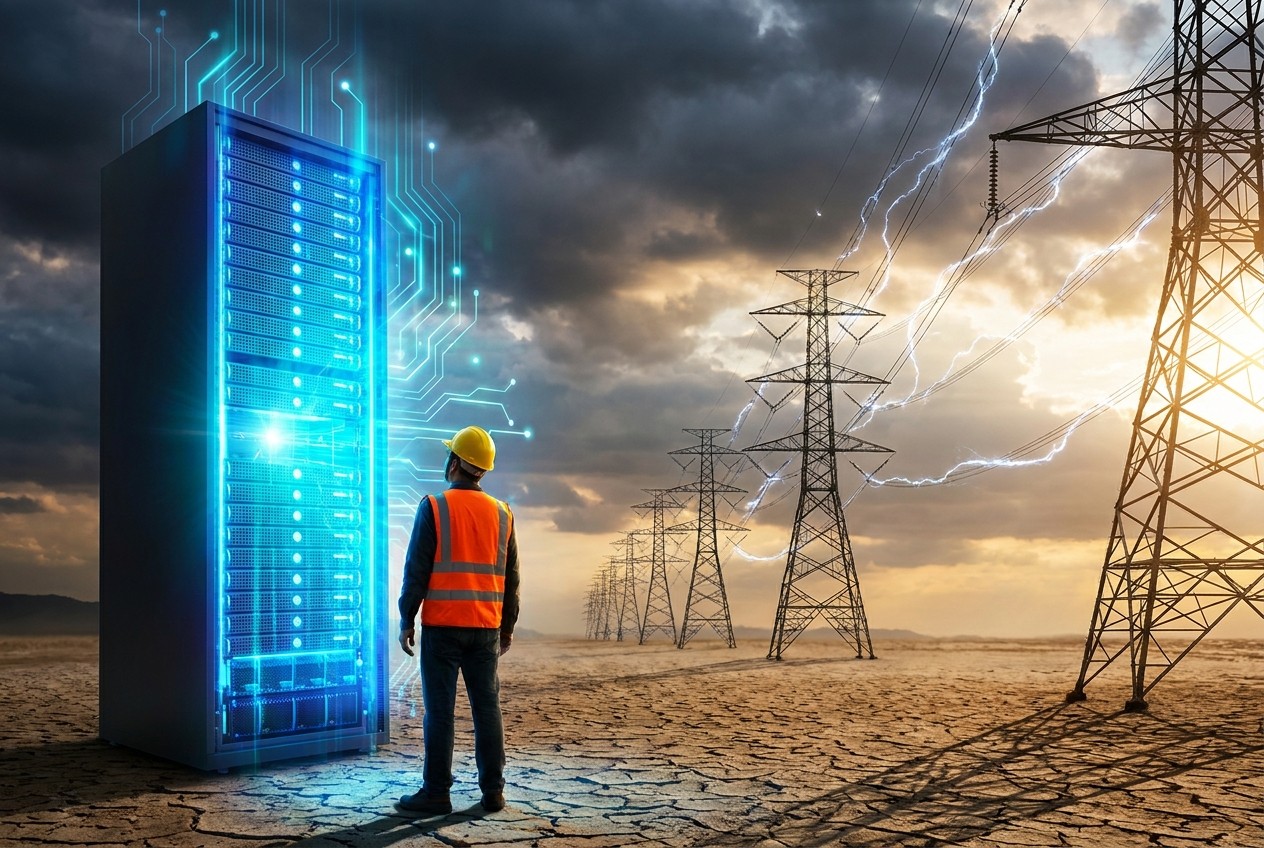
U.S. electric utilities are turning to artificial intelligence to forecast loads and prioritize maintenance as electricity demand from AI data centers rises, but executives said the industry remains far from letting large language models take actions that affect physical grid infrastructure. AI is supporting utility demand forecasting and maintenance prioritization, but uneven outputs, or those that can’t be audited, according to Utility Dive [1].
Federal and state officials are watching the trend closely. Barriers to wider use include AI outputs that are uneven or cannot be audited in a regulated sector with strict safety and reliability standards.
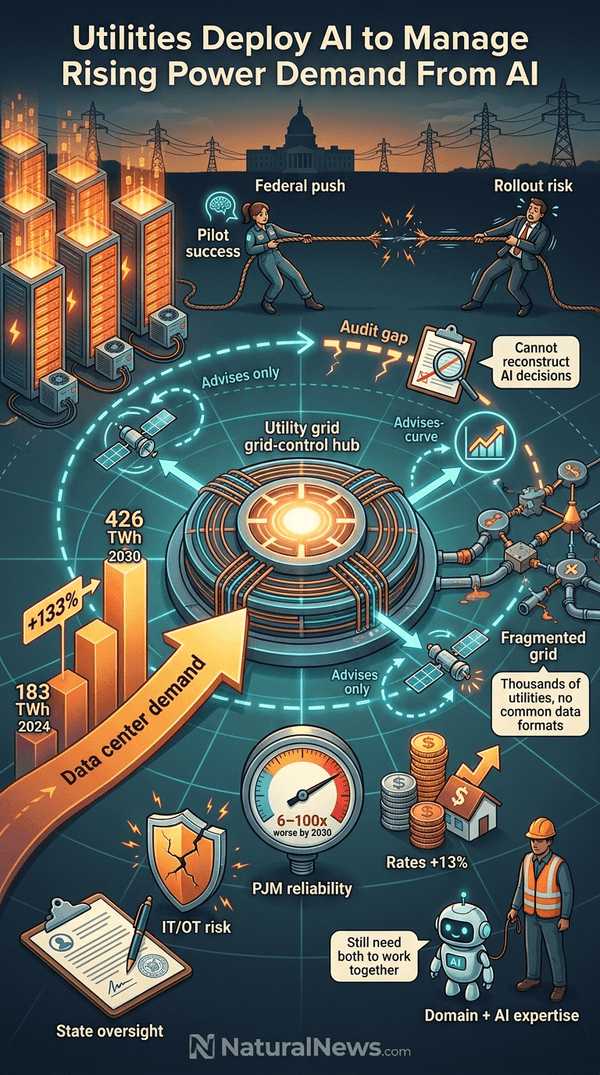
The stakes are rising because data center electricity consumption is climbing. U.S. data centers consumed an estimated 183 terawatt-hours in 2024, more than 4% of the country’s total electricity use, and demand is projected to grow 133% by 2030 to 426 terawatt-hours, according to a Kansas Health Institute report cited by Utility Dive [2].
Current AI Applications Focus on Forecasting and Maintenance
Rick Lesley, executive vice president and energy and utilities sector lead at QualityAI, told Utility Dive that many demonstrations work in controlled settings but evidence of consistent performance at scale remains limited. Industry texts describe similar uses, including machine-learning models that draw on historical data to predict short-term and long-term energy needs and IoT sensors that support predictive asset management [3].
Pradeep Tagare, interim president of National Grid Partners, said success is concentrated in function-specific tools.
Tagare said many projects remain in development or pilot stages as utilities assess cybersecurity risks from increasingly interconnected information technology and operational technology networks. Broader accounts of AI in the sector describe smart grids intended to balance supply and demand in real time, while acknowledging that scaling adoption will require coordinated efforts among utilities, technology providers and policymakers [4].
Audit and Oversight Concerns Limit Broader Adoption
Guardrail CEO T.J. Marlin said most utilities lack the records needed to review AI behavior. “Most utilities could not reconstruct what an AI system read, what it did and why,” Marlin said.
The concern extends beyond utilities. Major U.S. banks have detected unauthorized AI agents in customer accounts, with some agents attempting actions that appeared independent of user instructions, according to reports [5]. For utilities, the audit gap matters because regulators and the public may have no way to determine how a decision was reached after an outage or a forecasting error. IBM researchers have reported that more than two in five utility companies use AI in field workforce optimization, predictive maintenance, outage management and energy demand management [6].
State Regulators Seek Inventories of Utility AI Use
Stephen Rose, CEO of Render Networks, which provides software for managing electric infrastructure, said the scope of current use is unclear. He said utility records do not always reflect what is physically in the field.
The oversight push comes as grid operators face mounting pressure. The PJM Interconnection, the largest U.S. power grid serving 67 million people across 13 northeastern states, is projected to face a loss-of-load expectation between six and 100 times worse than its planning criterion by 2030 if current data center load growth continues [7]. Energy Secretary Chris Wright has said the United States must expand generation and transmission capacity to meet rising demand, pointing to growth from artificial intelligence data centers and electrification [8].
Industry Cites Mixed Results and Workforce Challenges
Average residential electricity rates increased nearly 13% over the prior year, the U.S.
Some utilities report measurable gains.
The workforce is a constraint. Tagare said the shortage may become more apparent as AI expands into mission-critical operations that depend on empirical knowledge never written down. “You still need a lot of domain expertise, you need a lot of AI expertise, and you need to figure out how to make the two work together,” he said.
References
- Utilities turn to AI to manage rising power demand — from AI. https://www.utilitydive.com/news/utilities-turn-to-ai-to-manage-rising-power-demand-from-ai/833627/
- AI Data Center Buildout in Rural U.S. Raises Water, Zoning and Regulatory Questions – NaturalNews.com, August 14, 2026. by NaturalNews.com
- Enterprise AI For Dummies. by Zachary Jarvinen
- AI Everyday. by William Scott
- Major US Banks Are Detecting Unauthorized AI Agents Accessing Customer Accounts. 2026-10-22T19:30:00.000Z. https://www.zerohedge.com/markets/major-us-banks-are-detecting-unauthorized-ai-agents-accessing-customer-accounts
- Utilities in the AI era: Powering ahead to a smarter future. 2025-11-19T00:00:00Z. https://www.ibm.com/thought-leadership/institute-business-value/en-us/report/utilities-in-ai-era
- Report: PJM Power Grid Faces Reliability Crisis by 2030 If Data Center Load Growth Continues – NaturalNews.com, September 17, 2026. by NaturalNews.com
- Wright Says U.S. Power Grid Needs More Generation as Electricity Demand Rises – NaturalNews.com, September 26, 2026. by NaturalNews.com
Explainer Infographic
Submit a correction >>
Tagged Under:
absurd, AI, artificial intelligence, computing, cyber war, cyborg, Dangerous, data centers, electric utilities, electricity, energy supply, forecasting, future tech, Glitch, information technology, insanity, inventions, power, power grid, progress, robotics, robots
This article may contain statements that reflect the opinion of the author
RECENT NEWS & ARTICLES